
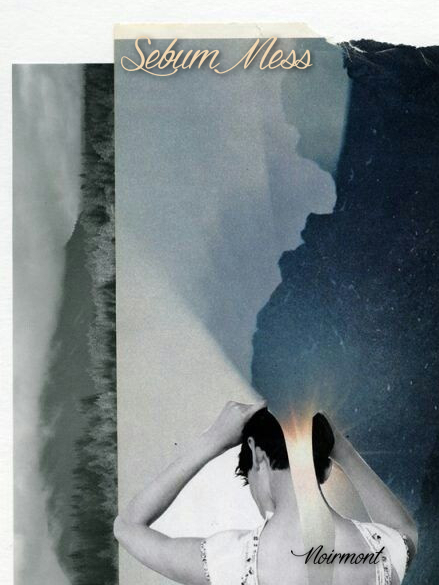
Do my arteries shudder in pumping blood?
Do my veins hurriedly cross
akin to doomed wires
ripping from their capillaries
And rendering me useless?
My joints crinkle at the source, singed, disjointedly fossilized
Muscle flaps lazily against the shore, splaying out
Vanishing in this sea of flesh I’ve made
sweat beads and stuffs my pores
It’s a sebum mess
I do not feel well, I am ill, surely it is my body that betrays me
And not my mind
No enemy to my service, a stoic ally
Shattering prattle
And whisking me away
Where is its intestinal fortitude now?
Nullified in this nirvana I’ve made
The navy sea, glistening with faint glimmers of coral and the moon
Beating down like a predator
When there is no other adversary.
Concocted, manufactured, essentially imagined
And scoffing in such a manner
That only celestial bodies can
When they are neglected.
It is a habit that demands attention
To succumb is inevitable
I will worship it and
imagine nothing else
O miraculous eternal spirit, iniquitous enemy!
With your gossamer spinster fingers
I should snap you like a twig
And wrestle you into mud
Grody discolored nails scratching my scalp
Mangled screams making me deaf as you inhale the earth
It fills your lungs
Now I stink of the moon’s mire
It mixes with the rich copper of my blood
And slicks me in the bog that hums with the warm air
Of this black night
This bodily weapon
Hath strangled its host
And snuffed her out
(Though not for lack of effort
to banish it peacefully)
Points:
Time spent:
IP address:
Canary word: Present
Possible AI signals:
Original Text:
Are you sure you want to delete this comment? This cannot be undone.
Mark this comment as a review? Points will be awarded to the poster.
Your comment was posted, but it wasn’t long enough to count as a review. Reviews need about four complete sentences (at least 250 characters). Try writing another review that explains your thoughts in more detail — the author will appreciate it, and you’ll earn points for it.
142,516 Literary Works • 678,249 Reviews



Hello, welcome new user!! The impression I got through this poem is that it is an eloquent, almost lyrical without being blatant, piece which adds a unique quality for itself. I admire that there is some trust placed on the reader to wonder about if the speaker's state of crisis is a struggle with body vs mind (that suggests a significant portion of their fate may be caused by a psychological part in this horrifying creation)--it does not just complexity in these feelings for the speaker, but also complexity as a writer!
This beginning introduces imagery drawn out in questions, which does incite interest without being repetitive about the structure this imagery wants to remain in. This wonder from the speaker "fades into" the scene rather than being direct, which seems fitting for the overall poem focusing on showing! Though, I do think some placement of the adjectives and grammar choices does make some lines a little convoluted, and I think it would benefit the poem to adjust some of these choices and experiment with them more. Some insight on these lines would be nice to hear if possible! I will be giving more insight on not technically criticisms, but concerns:This poem heavy contains a variety of language & adjectives which is impressive!--on the topic of language, though it may potentially shift for the body horror to further lose its impact as the focus is to decipher the horror instead of feeling it, I am in the belief that the variety here is for the most part comprehensible and in fact often elevates the tone and incomprehensible going on. The language isn't too articulate to not reach to the audience without them being in specific niches, which is great for more understanding. However, variety of adjectives may potentially stiffen horror, make it too poise and tight-fitting, without letting the images build up for itself. Personally, the placement of a few adjectives does bloat the poem a bit where there potentially could be more opportunity for a better flow.
"Do my arteries shudder in pumping blood?" -- this grammar doesn't make sense to me, and "in" should probably be "when" (i could be wrong about this though!).
"akin to doomed wires / ripping from their capillaries /" -- while the grammar correct, I do think the "doomed" adjective adds little for such a word that packs heavy meaning and constricts the flow. Since, instead of building up to a terrifying image, it relies on a terrifying word to make that feeling across. I personally would suggest to take it out for the sake of better pacing, and impact!
The line "Muscle flaps lazily against the shore, splaying out" also feels a little bloated itself from "flaps lazily" - perhaps you could take out "lazily" as it doesn't affect the scene much, or, generally experiment with the sentence structure to see.
To know you are ill but have difficulties grasping the extent of if this is an act of your body's instincts or if it's the mind negatively impacting you in some way is excellent when it comes to body horror, and really expands more on what makes body horror horrifying and what makes body horror very specifically a bodily thing if the body and mind is sometimes one in the same. There is a lot of potential in poking at both the mind & body working at odds or similar, and it is touched here very interestingly as a question with an ambiguous answer.
The first quoted line extends on the question of body vs mind, but also leads towards the topic of celestial bodies existing, which is really interesting (the mention of the moon, associated with the celestial, also leads towards the point)! Their existence relates the question of "body vs mind" in regards to this body horror evolving, as the perception of the celestial bodies though the lenses of them being grounded in reality vs them being founded in belief (or "Concocted, manufactured, essentially imagined") fuels (other than paralleling) the question of the body vs the mind. This unreliability of the speaker does create these angles on these celestial bodies' existence: Maybe these celestial bodies exist because of the force onto their body, or exist due to their mind being forcing their body to go through horror-- there can be many ways that make celestial bodies are real to them. What matters most is that they feel it and at the moment, that's the most vivid, realest thing that is happening to them while going through a similar process that is body horror.
It is truly intriguing how the act of worship transitions into this violence I am unsure is directed at themselves, celestial bodies, or both. What matters is, they have completely turned into something else very disconnected from the beginning. As the reader turns into a "sebum mess", I wonder if this body horror meant degenerating into bodily instincts--as if they now perceive their circumstances through the lenses of being prey. Or--considering this is described after a prayer, somehow this celestial body has affected the speaker. The way the descriptions rests into the body horror makes me inclined to think of both.
The shift towards archaic language, "hath", while the rest of the poem shifted into modern english was striking.
To experience this poem was like a journey itself. I re-read a couple times, intrigued by the ambiguity but the clarity of images. I do not get where the speaker ends and begins throughout the poem, except for the beginning at a state of confusion. The speaker loses themselves to body horror, the celestial bodies, in worship, in condemnation, later the moon (which i would like to see expanded on to know "who" or "what" it is), and finally fighting back a host. These are much ideas packed in a poem that gives it more complexities, but does feel a bit disconnected from each other to the point of being somewhat disorienting--not really just in a way that feels like emphasis on the horror (which is great! and is shown in some parts of the poem!), but also in a way it doesn't feel the most intentional (which isn't the worst thing ever, but there could be more work on what the focus should be!).
Regardless of how I feel about how these topics are written, to use various of ideas to draw into the theme of consumption was well done. While there have been bits of criticisms & concerns here and there, I want to say that overall, it was a wonderful experience reading this piece that was crafted with so much creativity that lasts throughout itself! Keep writing!!
My first thought is that this is a poem about the body becoming an enemy to its inhabitant, but obviously there's something more psychological underneath the physical presentation of your poem.
I find the relationship between the body and the mind intriguing , especially how the body gradually becomes something you seem to be at war with. There's a contradiction in wanting to separate oneself from one's own physical existence, almost as though the body has become an adversary that must be confronted. This is quite an unfamiliar approach, considering the mind is usually perceived as the origin of most of our problems.
I also enjoyed the imagery, the comparison of veins to doomed wires and the transition from bodily discomfort into something almost supernatural. The moon, the sea and the eventual confrontation with this mysterious entity give the poem an unsettling atmosphere.
I' want to understand the identity of this adversary. The references to habit, worship and inevitable surrender suggest something beyond physical illness, perhaps an obsession or compulsion that has gradually consumed you?. It could be a destructive habit or even a psychological condition that you've personified. The ambiguity surrounding the identity of this adversary is, to me, the heart of the poem and perhaps its most interesting quality.
I do wonder, however, whether some of the imagery could be connected more deliberately. At times, the poem moves between several metaphorical landscapes without fully developing their relationship. It almost seems more invested in sounding grotesque than in allowing some of its imagery to develop.( Not a critique just an observation & a thought)
The ending also caught my attention. I like the idea of the body becoming the very weapon that destroys its host, though I think the parenthetical explanation slightly takes away from the impact of that final image. Perhaps a more restrained ending would leave a stronger impression I believe.
Overall, there's an intriguing idea here, in the conflict between resistance and surrender.
You begin by trying to identify and fight an enemy, only to discover that the enemy is inseparable from the very thing they occupy. At least, that's how I interpret it.
Either way, your imagination and the transitions you've created are top-notch. This is chilling.