
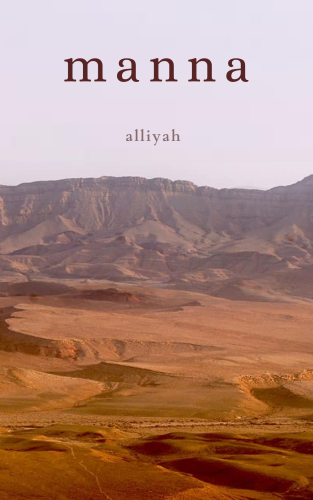
i count the spaces between my ribs like a tally of unanswered prayers / my body is an empty basket; heavy from hollowness / and i am tired of trusting tomorrow for my bread / lost enough to long for Egypt (even when i know the sea would swallow me whole) / He answers my heart-grumbles with sun-rise and sparrow-song and frost on the ground / i do not want to listen / He tells me to trust Him / but i am starving; i am an empty cistern, Jonah's whale, a gaping ossuary. / so i swallow every promise whole; and try not to choke on quail feathers.
a little boy holds out his lunch; loaves and fish, coriander and dew / he gives the Savior everything / and i am ashamed at all the manna i’ve been keeping in my pockets / i put my hope in the offering-basket as it passes by / and ask God if He can use my crumbs.
He unfolds my hands white-knuckled, thumbs bruised from prayer / and plants a seed of mustard-grain / whispering, “stop holding bread, hold Me instead.” / i let my palms become soil, become ready-manger, become sky-waiting-for-starlight; calloused, broken, open / Sarah laughs with Sarai this time, sharp but clear like the desert-wind, “Listen child, tomorrow is soon.” / this time, i laugh with her too, if only to fill the space in my ribs before the tide comes in.
Points:
Time spent:
IP address:
Canary word: Present
Possible AI signals:
Original Text:
Are you sure you want to delete this comment? This cannot be undone.
Mark this comment as a review? Points will be awarded to the poster.
Your comment was posted, but it wasn’t long enough to count as a review. Reviews need about four complete sentences (at least 250 characters). Try writing another review that explains your thoughts in more detail — the author will appreciate it, and you’ll earn points for it.
142,241 Literary Works • 677,072 Reviews




*** Scripture Reference Notes ***
Spoiler
A reader who isn't familiar with some of the above scriptural references within the poem may benefit from reading these passages that the poem references:
The Sea that God parted for the Israelites to escape Slavery
Exodus 16 - Manna & Quail - Bread from God for Today
Jonah 1 - Jonah swallowed by a hungry fish that God sent to save him
John 6 - God feeds crowd through a little boy's lunch offered up
Matthew 17 - Faith the size of a Mustard Seed is enough
John 6 Continued - Jesus says "I am the Bread of Life / the better Manna"
1 Kings 19 - God speaks in the still small voice in the desert, and feeds Elijah a snack so he can get up and go back to his purpose
Genesis 18 - Sarah laughs at a promise too good to be true
Genesis 17 - Sarai renamed Sarah - Abraham also laughs at the promise
I also was inspired by the Midrash account of Nahshon who was the first to enter the red sea, he jumped even before the sea split because he had faith that God would show up and split the sea -> can read here
Hi alliyah! I have loved reading your poetry previously and this is such a beauiful piece I knew I had to review it today!
I'm not Christian, and I don't believe in any religion or God, but I do have a strong fascination with Christian imagery, scripture, the Bible and particularly Jesus (I have a wall in my room dedicated to postcards I find of Jesus & Mary), so I'm hoping my informed yet secular view will offer some useful insight and not be too off the mark!
It's very interesting to me to start off with the imagery of ribs. It first evoked the image of God creating Eve out of Adam's rib, and perhaps there's something to that here too, showing the ribs as the site of both creation and lack, like a body built from someone else's fullness now counting its own emptiness. It also evokes the idea of starvation or hunger. Ribs are what show when a body is starving, so the "tally of unanswered prayers" sounds like the narrator is physically wasting away, and that their prayers are not being answered.
Something empty would usually be light, but here it is described as heavy, and this tells me this isn't peaceful emptiness, but a burdened one. Perhaps not having faith in the saviour is making this empty heaviness.
I see in your stickied comment you were inspired by the Midrash account of Nashon who entered the red sea before it had split because he had faith. So here, the narrator has lost their faith, since they think the sea would swallow them, and God would not part it for them.
God's response is so tender here. But the narrator is not comforted by the beauty of the natural world, they do not want to listen. Perhaps they need something stronger to test their faith.
Okay wow, I was so blown away by this stanza. It's a tonal shift from the emptiness and starving of the first stanza. The boy may have nothing else left, and he still offers all he has to the saviour. I know manna is a food God gave to the Israelites in the bible, and that it is special, and yet the narrator has been hoarding it. I think Manna, in Exodus, couldn't be hoarded, and anyone who tried to save it overnight found it rotten by morning, right? So that is why the narrator can only give crumbs.
This gave me chills. There is so much tenderness here, forgiveness and belief. The saviour plants a seed so that the narrator can grow and no longer be empty, their faith can grow and develop as the plant would.
I honestly have no criticisms or critiques to give; this was wonderful <3
hello Juke here! as not only a Christian myself but also as a fellow writer, this is … absolutely amazing. the word choice is v. clear and upfront eye candy; the soft italic quotes you use give it wholesome life, and your Scripture references click together seamlessly.
idk why but i really loved the line
the name change from Sarai to Sarah (‘Princess’) signifies Sarai becoming a new version of herself, the mother of a looot of influential Jewish patriarchs. i also wanted to make a connection of this line to the book of Galatians, in which St. Paul compares the slave Hagar to Sarah to juxtaposition the old and new covenants established by Christ. he says we are made free by the new covenant and are children of the free woman (Sarah), not the slave woman (Hagar), and your poem kind of reminded me of that - as children of the new covenant we can laugh with that old version of ourselves, the husk bound to the old covenant.
this may be a v. wild interpretation, but that’s how i saw it
~Juke
Thanks so much for the lovely interpretation! <3 Right on with the name change too - I think the renaming of folks in the scriptures is very poetic in itself, and reminds us how we are made new in Christ (even when the old still burdens us, Christ is more powerful yet). Thanks for stopping by!
Blessings <3
A
Hey! I absolutely loved this poem. I love the imagery you've used, the hunger, the bread, everything is so beautifully put together, representing longing, faith, and uncertainty. The initial imagery really hooked me in with the counting the spaces between your ribs like "a tally of unanswered prayers". It just immediately brought this sense of this empty, unfulfilled feeling without even having to explain anything.
I also loved the Bible references. Egypt, manna, Jonah, loaves and fishes, mustard seed, and Sarah all tie together the themes of the poem so beautifully. It felt all connected together instead of just randomly using names and places. My absolute favorite part of this poem was probably the little boy offering his lunch and the speaker realizing how much "manna" they had been clinging to. Just such a beautiful and heartbreaking imagery.
The imagery in the final stanza is beautiful as well. The hands unfolding until the palms become soil, a manger, then the sky waiting for starlight is such a lovely ending, almost like a prayer.
I loved the juxtaposition of being hungry of something obtainable and being told to have faith in something you can't see. The poem doesn't romanticize faith and belief; instead, the speaker is still struggling in their faith, which makes the outcome all the more heartwarming.
I feel like this poem is the most personal, spiritual, and beautifully crafted piece I've ever read. I just loved the beautiful and lovely imagery the poem contains. It was truly captivating, and the ending left me in a really nice sentiment. Beautiful work! <3
Hi hira, very sweet review - thank you! I appreciate the comments and interpretation - was really trying to hit that mark of portraying *exhausted* but not *utterly hopeless* which can happen so often in faith - that endurance to continue in-spite of lack. Glad that tension seemed to come through! Thanks for stopping by. Blessings!
A