
Published November 2, 2026

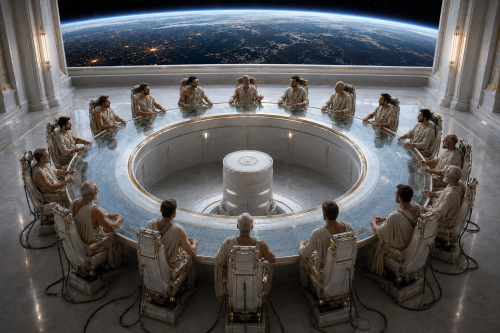
We, the seventeen who will never meet within this lifetime, have been chosen for a curious purpose beyond our time. We made a tacit covenant and coined the phrase “Futura Ignota,” yet we would not realize this phrase except through prolepsis.
I, like the other ordained, have been sought out to diversify our vocation.
The Aionqara and Crasantü had a strange series of overlapping anomalies. The Aionqara were a forgotten civilization of Hellenic origin, advanced beyond modern comprehension. They were a wondrous group. They deciphered a tenebrous prophecy that foretold a future phenomenon that could truly only be described as perdition.
Like the Aionqara, the Crasantü came to the same conclusion. The Crasantü were a curious people, said to have descended from rogue Roman sailors who discovered a distant, unknown continent. After a century-long peregrination spanning multiple generations, they eventually mingled with an Andean native group.
The only problem was that they lived 12,650 kilometers apart, and the Crasantü were far younger than the Aionqara by about five hundred years. How the Crasantü could have discovered the same fate, having never known of the Aionqara, remains obscure.
What is known is that this history was eventually erased according to the will of the Order.
To the common man, history is this long chain hauling empires, revolutions, war, and progress. Yet what they do not realize is that the reality they inhabit is a beautifully manufactured machine, oiled by torn hands that they would never see, whose roar muffles the sounds of the true cylinders shifting.
What a machine is, I couldn’t tell you; it just felt right to say.
The Order chose invisibility. By systematically dissolving their own names from the ledger of time, the Aionqara and the Crasantü ceased to be historical casualties and instead became the architects of our reality. They retreated behind the veil of mundane existence, allowing humanity to play its trivial games while the true work continued in the dark.
And now, that work requires us: the seventeen.
When I enlisted in the legions, I had to go through many hardships. Training was rigorous. Life at this time consisted of sacred oaths and countless nights spent hearing men weeping for their comrades who would never march home. Rebellions within the empire were bloody, barbaric things. The nights after confrontations were the worst; men would drink themselves to sleep on those tearful nights.
The Grove of Baduhenna was a place that would resonate within every legionary who served under Lucius Apronius. Even Tartarus has better attributes than that vorago. The Frisii were fed up with Roman demands for tribute. Olennius, a former primipilaris appointed to oversee the Frisii, demanded hides of aurochs as tribute, imposing a burden they could scarcely bear. When they could not meet his demands, the burden extended to their cattle, lands, and eventually their wives and children—a greedy and hotheaded act. They revolted brutally.
Now it was up to our governor, Lucius Apronius, to restore Roman authority. He marched his forces north, and I was included within their ranks. Adrenaline and excitement coursed through our veins as we travelled down the Rhine and entered Frisian territory. We felt invincible. We believed it would be a textbook Roman operation. That was far from the truth. By the time we arrived, the siege of the Roman fort had already been lifted, and the rebels had dispersed to defend their own possessions. As the fighting commenced, the Roman auxiliary forces were driven back. It was not until the soldiers of the Fifth Legion entered the fray that the enemy was driven back and the beleaguered Roman forces were rescued.
But whatever confidence we had regained would soon be shattered. News began to reach us of the slaughter unfolding within the Grove of Baduhenna. The fighting had continued well into the following day, and the reports were dreadful.
A hell brought by men who did not fear God.
It was a disaster. It was said that the swamp had consumed them, like a wild boar feasting filthily upon waste in the open-air sewage heading into the Tiber. Nine hundred Roman men were slaughtered at the Grove of Baduhenna. Four hundred others, having taken refuge at the villa of Cruptorix, feared betrayal and slaughtered each other.
Overwhelmed, those of us who remained left our dead unburied. One of the recruits, upon learning of the slaughter, went to “aid” his comrades. I do not want to finish this anecdote. Emperor Tiberius concealed the scale of the defeat from the public. Those of us who survived were, in the eyes of Rome, fortunate enough to continue serving. Some of the “brave and fierce” survivors were deemed worthy of a promotion.
The legion commander pulled me from the standard infantry lines because of my performance during the campaign and assigned me to serve as a speculator. Oh, what an honor that is.
I eventually made it to Judea. I was assigned to the prefect’s headquarters as a speculator, having been transferred from Germania after my service there. My immediate duty was to guard one of our senior tribunes. It was a troubled time in Judea, and a standard local guard would not be enough in those days. It was a hotbed of unrest. We—the other speculatores and I—would go on many errands at his side. Wherever he wandered, we shadowed him. We were special intelligence; we had to dig into plots and schemes that could threaten him. There were angry mobs chanting right outside the praetorium, which promptly worried him.
The whole city—no, all of Judea—was up in arms over a troubling and difficult decision concerning a mysterious man. This case was a political nightmare, and it had the prefect in a strong chokehold. That event led to my tribune becoming fully involved. It was as if he found out his friend was losing bets at a popina, laughed at him, and then found out he had put the bill on him. Yet this was no tavern joke.
There was talk of revolt-level actions that could take place if the situation was not dealt with swiftly. Then, one morning, a decision was made: this mystical and mysterious man had been sentenced to death. Under the prefect’s decision, he would be executed at Golgotha around the third hour.
My tribune was eager to see the fate of this unknown man, so, at his command, we mounted our horses and rode in his shadow. We arrived at the site where the man was to be crucified. It seemed that we were there not just out of curiosity but rather to ensure that the unrest was suppressed and the troublesome dealt with. That was at least the impression I had based on my tribune’s attitude and glare.
Between dawn and dusk, my already complex grasp of reality would be completely altered and left debilitated by an event that would never be denigrated by the trifling whims of man and the clash of cognitive empires. From that moment onward, I would be bound by an unrelenting need to contemplate mysteries that, even with eternity at my disposal, I might never fully comprehend.
At present, I have received orders to reconnoiter the region. Therefore, I shall depart to conduct the reconnaissance. I must examine the roads approaching Jerusalem and determine the movements and positions of the rebellious forces.
I am to proceed toward Antipatris and investigate the routes by way of Lydda and Beth-Horon. These assignments vex me, as they keep me from my more important duties in this province. Nevertheless, I anticipate making efficient work of this undertaking, and I shall continue this record upon my return.
Should this be the final entry in this record, then some unforeseen circumstance must have befallen me during my assignment.
Victor Antonius Marinus
A.D. XVII Kal. Oct.
Consulibus C. Luccio Telesino et C. Suetonio Paulino.
Author's Note: Sorry if this makes no sense right now—it’s a work in progress! I'm mostly posting this to see if people like the introduction. I would absolutely love some feedback, so please let me know if you would keep reading if I wrote more!
Points:
Time spent:
IP address:
Canary word: Present
Possible AI signals:
Original Text:
Are you sure you want to delete this comment? This cannot be undone.
Mark this comment as a review? Points will be awarded to the poster.
Your comment was posted, but it wasn’t long enough to count as a review. Reviews need about four complete sentences (at least 250 characters). Try writing another review that explains your thoughts in more detail — the author will appreciate it, and you’ll earn points for it.
142,420 Literary Works • 677,766 Reviews

Hi! I’m here to leave a "short" review of your manuscript.
 . I will read the next chapter when it comes up!
As you mentioned at the end, some of the terms and certain parts don’t seem to make much sense just yet—but, honestly, that actually works! It hooks the reader, keeping them engaged because they want to find out more. I like that you chose to write in the first person; it’s a great touch—I don’t see many writers doing that.
One small note: there’s one instance where you use a numeral—when you mention the distance in kilometers to show how far away the Andean are—try to avoid using numbers. Instead, describe the terrain that separates them and the physical challenges that entails. I really like the length of your paragraphs and your narrative style. But be careful with the fact that you are close to loredump stuff.
But yeah, I like it! I wanna read more
I hope this helps!