
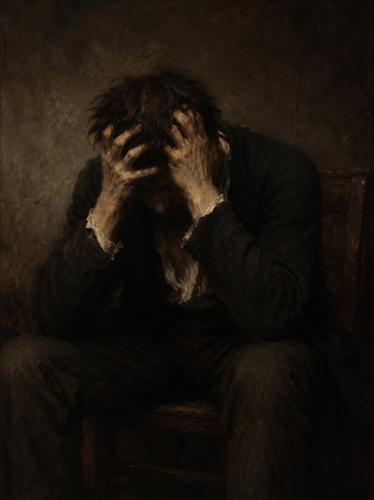
Warning: This work has been rated 16+.
Oh, tell me,
what crime was mine before the altar?
What name did I bear
that made you so determined to remember me?
What have I ever done to you?
Why can't I suffer in peace?
Remember, had the choosing been mine,
I would never have entered this covenant with you.
You've been the blemish upon every horizon,
the uninvited shadow at the foot of my bed.
You said you needed no spectators,
yet demanded my participation.
And here I am,
my mind,
my soul,
my flesh,
all conscripted into the business of deciphering your commandments.
Still, you find me wanting.
I bury my seeds beneath the earth,
and you come at night with your little shovels.
Whatever escapes your fingers
and dares to break the soil,
you gather before it learns the language of fruit.
You leave my flowers to inherit the drought,
and lace the beds of my dreams with mayflies,
so that even in sleep
I might remember the brevity of my tenancy.
Tell me,
what pleasure do you derive
from hurling bricks at a man ascending your staircase?
Do you laugh when I stumble?
Does the architecture of my misery amuse you?
Have you not grown weary
of rehearsing the same tragedy with me?
Since my tender years,
we have performed this ancient ritual,
you, the executioner,
and I, the recurring sacrifice.
And after all these years,
the verdict remains unchanged.
Isn't it time we altered the terms?
I challenge you.
Yes, you heard me.
A challenge.
If this must be a duel,
then let the weapons be equal.
Remove your thumb from the scales.
Let the heavens abstain from choosing sides.
Give me a chance.
Step aside,
and watch what becomes of a man
when he is no longer occupied
with surviving your inventions.
I'll make this interesting for both of us.
Surely, suffering is not the only spectacle
your ancient eyes have learned to appreciate.
Give me a fair contest.
Give me room to breathe.
But if you insist on this arrangement,
if the game must remain rigged
and the harvest forever belong to you,
then, by all means—
"Turn me over. I'm done on this side."
Points:
Time spent:
IP address:
Canary word: Present
Possible AI signals:
Original Text:
Are you sure you want to delete this comment? This cannot be undone.
Mark this comment as a review? Points will be awarded to the poster.
Your comment was posted, but it wasn’t long enough to count as a review. Reviews need about four complete sentences (at least 250 characters). Try writing another review that explains your thoughts in more detail — the author will appreciate it, and you’ll earn points for it.
142,603 Literary Works • 679,059 Reviews



Ok, so my first thoughts are the narrator is talking to someone he considers responsible for his suffering, like maybe God, or fate or just life in general. Right at the opening, we see the narrator question why hes being treated this way, like he's being punished for something, even though hes not sure what for.
The seeds and the flowers are a really interesting metaphor. I didnt get it at first, but i think it represents the narrators work, like his effort and ambitions, but whoever he's addressing keeps interfering. Everything the narrator tries to grow gets ruined. which is like something gets in the way every time hes trying to make something good for himself.
and then onto the staircase, i think this represents the narrator attempting to achieve something greater, but things keep getting thrown at him, and hes not allowed to progress.
Then, instead of wanting a better life, the narrator wants a challenge: a fair contest. He just wants the chance to work at succeeding without feeling like the odds are against him. And i think this could mean two things for the narrator. Like, does he believe he can win this battle if the odds were even, or is his challenge just his way of refusing to give up?
this is shown well in these lines:
"Step aside,
and watch what becomes of a man
when he is no longer occupied
with surviving your inventions."
because i think what the narrator is saying here is, "just imagine what i would be able to do if i wasn't always busy trying to survive all that you throw at me".
And after all that, the narrator ends with "Turn me over. I'm done on this side." It shows how exhausted and frustrated the narrator is with the situation. Its like hes saying, "if you wont make things fair, I'm done. whatever comes now, comes."
This poem was cool to read, and gave me lots to think about! I really enjoyed reading it!😄
This piece is an absolute masterclass in vulnerability, striking a profound balance between raw, unfiltered emotion and deliberate poetic control. From the very first lines, there is an immediate atmosphere of intimacy that makes the reader feel as though they are stepping directly into a private sanctuary of thought. Your choice of language is incredibly precise; every noun and verb feels weighted with historical and emotional significance, avoiding the common trap of cliché by grounding universal feelings of longing and grief in deeply specific, sharp imagery.
What struck me most was the pacing and internal rhythm. The way you manipulate the line breaks creates a natural rise and fall, mimicking the erratic breathing of someone caught in deep contemplation. There is a palpable tension in the whitespace itself, forcing the reader to linger on the pauses and absorb the weight of what is left unsaid. The mid-poem shift or "turn" was particularly devastating, gracefully recontextualizing the earlier stanzas and building toward a quiet yet resonant conclusion. It takes immense bravery to lay one's heart bare on the page like this, but it takes true craftsmanship to shape that vulnerability into art that feels so universally accessible yet fiercely personal. This poem did not just demand to be read; it demanded to be felt, lingering in the mind long after the final punctuation mark. Thank you for sharing such a beautifully moving, evocative piece of writing.