
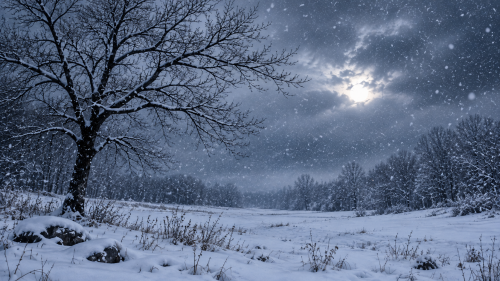
In the mid-bleak winter,
when trees relinquish their leaves, and flowers retreat beneath the earth, when the sun grows estranged from its warmth, and daylight becomes a fleeting visitor,
the world learns the language of waiting.
In the mid-bleak winter,
some plants perish, some seeds surrender themselves to dormancy, buried beneath the indifference of the soil, where the cold, paradoxically, becomes the condition for their awakening.
Some are already ripe for harvest. Some have yet to take root. And some—
are never meant to see the spring.
Beneath this spectacle of apparent death, roots cling to what remains, seeds negotiate with the darkness, and certain plants hoard the remnants of life, preparing for a season they have not yet seen.
Winter does not always destroy the harvest; sometimes, it merely postpones its arrival.
Or so they say.
In the mid-bleak winter,
everything comes to a standstill. Naturally, there must be a reason for this. A necessary order to the dying, a purpose concealed within the stillness.
One must believe there is.
But is there?
For nothing is ever quite as it appears.
In my mid-bleak winter,
there is only cold, working its way into my bones, until even movement becomes a distant memory.
The roads have frozen. The paths are impassable. And even if I could move, what would there be to return to?
My plants lie beneath the earth, awaiting a season of their own. Or perhaps they are already gone. The few that remain are all I have left.
In the mid-bleak winter,
one is afforded time to prepare. Or so one is led to believe.
Yet why does it always arrive with such violence? Why does familiarity never make its arrival gentler? Why does every winter feel like the first?
It comes in the night, like a thief, without announcement, without ceremony, and leaves with what took seasons to cultivate.
It steals the harvest, the labour, and sometimes the very will to begin again.
In the mid-bleak winter,
while everything lies suspended between what was and what might yet be, I am here, retracing my steps.
Where did it go wrong? At what point did the ground give way? What could I have done differently?
I had seen it coming. I had watched the horizon darken. I knew, somewhere within me, that the season was turning.
And yet, it caught me unprepared.
Now I stand in the open, without shelter, watching the cold claim what remains.
In my mid-bleak winter,
everything awaits its fate. Some things perish quietly, others endure without knowing why, and a few, perhaps, are learning to survive.
I hope I do not freeze before the thaw. I hope the remaining seeds find some reason to take root, that whatever has survived beneath me will not have survived in vain.
In the mid-bleak winter,
if I should make it through the cold—a possibility I entertain with little conviction—
how does one survive a winter without shelter?
Build one?
Yes. I am trying.
With hands that can scarcely feel, I am gathering what remains, trying to construct a refuge against a season that has already found me.
But what if, come spring, not a single seed should break the soil?
What if the earth yields nothing? What if these hands, having laboured against the cold, never move again?
And if that should be the case, let it be known:
I tried.
I anticipated the winter, but anticipation is not preparation. To foresee a catastrophe is not necessarily to possess the means to survive it.
Sometimes, foresight offers only the cruelty of watching something approach without knowing how to stop it.
Perhaps I was racing against time. Perhaps it was impatience that hastened my undoing.
The season was not unfamiliar. I knew what winter demanded. I knew that all I had to do was build a shelter.
Yet I cannot tell whether the frost claimed everything, or whether, in my haste to survive it, I became the very thing that brought it all to ruin.
I cannot tell.
But I know this:
I tried.
Points:
Time spent:
IP address:
Canary word: Present
Possible AI signals:
Original Text:
Are you sure you want to delete this comment? This cannot be undone.
Mark this comment as a review? Points will be awarded to the poster.
Your comment was posted, but it wasn’t long enough to count as a review. Reviews need about four complete sentences (at least 250 characters). Try writing another review that explains your thoughts in more detail — the author will appreciate it, and you’ll earn points for it.
142,773 Literary Works • 679,888 Reviews



I really like the repetition of "In the mid-bleak winter," reminding us of the season and almost making it feel like everything is caught in this endless cycle. I especially like the way this changes to "In my mid-bleak winter," because it shifts from describing the world and the plants to the narrator's own experience. It's no longer just winter happening around them, but something they're personally going through.
All the imagery works really well, too. The plants, the seeds, the roots, the harvest, all preparing themselves, taking root, and holding on through the winter, though some will perish. I really like the way you use all of this to describe what the narrator is experiencing as well.
I think the overall meaning of the poem is really interesting, especially the idea that preparing and anticipating something doesn't necessarily mean you're ready for it. And i actually just read something similar to that idea in a book recently. The narrator knows winter is coming, yet still finds themselves caught unprepared. And perhaps all that preparation, all that trying to survive, might even have contributed to their undoing. I really like that uncertainty, not knowing whether the frost claimed everything, or whether the narrator's own actions somehow brought it all to ruin.
There's also this hope that all the plants' efforts, and the narrator's own efforts, won't be in vain. That whatever remains will survive, that the seeds will take root, and that eventually there will be a thaw. But it's such an uncertain hope, and the narrator doesn't seem entirely convinced they'll make it through.
And despite all that, they still try. They keep gathering what's left, trying to build a shelter, even when they don't know if it'll be enough. And in the end, that's all they really know: they tried. I really like that ending. It doesn't promise everything will be alright, or that their efforts will be rewarded, just that they did what they could.
I really enjoyed this. There's so much imagery and meaning woven throughout, and I really like the way the poem comes together. I'm glad you shared this! ❤️
Thank you so much for reading, flower! I really appreciate how thoroughly you've engaged with the poem and the different layers of its imagery.
I love that you noticed the transition from "In the mid-bleak winter" to "In my mid-bleak winter." I wanted that shift to mark the point where the observation of a universal experience gradually becomes a personal confession.
Your interpretation of the narrator's attempts at survival contributing to their own undoing is very sharp. That uncertainty was intentional. Sometimes, in our desperation to preserve what remains, we become so consumed by the urgency of survival that we fail to recognise how our own actions might be accelerating the very thing we're trying to prevent.
I suppose another question I wanted to explore was whether trying is always enough, especially when the outcome remains beyond our control. There were quite a few layers I deliberately left unexplored, if only for the sake of the piece.
I'm glad you enjoyed the ending. I didn't want to offer any assurances of spring or promise that everything would eventually be restored. The narrator knows one thing with certainty, amidst all the uncertainties: he tried.
Thank you again for such a lovely review. I was actually looking forward to your thoughts. ❤️
This is a wonderful poem.
I love how the idea of winter is hopeful in certain areas, before you knock it back down into a bleak, more realistic point of view.
The way you use repetition for poem is gorgeous. I especially love how even though you are using the repetition, the line varies between In the mid-bleak winter to In my mid-bleak winter. This shows there is a difference between the two perspectives, and you play that angle incredibly well.
The person is constantly wondering if all their effort will be worth it, if they have struggled through the winter in vain, before it finally settles on the message that at least they tried, at least they didn't give up and do nothing.
These two lines were my favourite, and I really appreciate how you put it into words so well. The way those lines talk about it, it explains a topic most people don't usually acknowledge in writing.
Overall, this is a compelling poem with a haunting message, I love your writing and can't wait to see what you write next.
This is your first review of any of my work, and it's such a thoughtful one. Thank you so much for taking the time to read and interpret my work so thoroughly.
I appreciate that you noticed the distinction between "In the mid-bleak winter" and "In my mid-bleak winter." That contrast was intentional, and I'm glad it translated the way I hoped it would. (It's actually quite sharp of you to notice that.)
it is interesting how we sometimes anticipate certain hardships, recognise their approaching presence, and yet remain inadequately prepared for their arrival. I suppose that's one of the main central questions I wanted to explore.
I'm glad those lines resonated with you, and I'm equally grateful that you found something meaningful in the poem. I'll take some time to read your work too.
P.S. I had no intention of haunting people with it, lol. I wrote it in anticipation of both defeat and survival.