
I am a sick man.
I have long since mistaken the wound for its physician;
perhaps that's why I never seek a cure.
I am a sick man.
Something has been rotting beneath my ribs.
The heart spills its red confessions,
the liver weeps what it cannot cleanse.
Yet the body persists.
My atrium has made a chapel of the poison,
and my arteries, those obedient little rivers,
have taught the flesh to mistake corruption for nourishment.
I am a sick man.
I have consulted the stars,
accused the shadows,
and suspected the hands of the unseen.
But no curse bears my name.
I know what ails me.
And God help me,
i know it knows me.
Points:
Time spent:
IP address:
Canary word: Present
Possible AI signals:
Original Text:
Are you sure you want to delete this comment? This cannot be undone.
Mark this comment as a review? Points will be awarded to the poster.
Your comment was posted, but it wasn’t long enough to count as a review. Reviews need about four complete sentences (at least 250 characters). Try writing another review that explains your thoughts in more detail — the author will appreciate it, and you’ll earn points for it.
142,799 Literary Works • 679,998 Reviews



This is short, but really effective. The narrator sounds desperate and in pain, and yet doesn't seem to seek a cure. It seems like this pain has been around for a long time, to the point where it's been mistaken for the cure itself. It just made me think of how sometimes we linger in our pain for so long, becoming so accustomed to it that we begin to ignore it. We start to think it's normal. And eventually, we become so comfortable with it that we no longer look for a way to deal with it, even as it begins to consume us. Maybe I'm reading too much into it, but that's what the beginning brought to mind for me.
I really like the imagery throughout this poem, especially "The heart spills its red confessions," which is such a cool way of putting it. I love the comparison between spilling blood and spilling confessions, and the way it makes the heart seem to reveal something that has been hidden.
I also like the repetition of "I am a sick man," interrupted by "Yet the body persists." It keeps reminding us that the narrator is sick and suffering, but despite that, his body continues on.
And as the poem progresses, the narrator begins looking elsewhere for answers, consulting the stars and accusing the shadows, even suspecting the hand of the unseen. But in the end, he admits that he knows what ails him, and that it knows him, too. I really like that ending. It brings the poem back to something personal, as though the narrator has been searching everywhere except where the answer truly lies. Back to my thought about ignoring our pain, I think this ending connects to that too—the way we might look everywhere for cures when we know the answer, but don't always want to admit it or deal with it, and so we blame other things.
I think this might be one of your shortest poems, but it's still just as amazing as all your other ones! I really enjoyed reading it!
Flower, thank you so much for taking the time to read this and engage with it so thoughtfully. I really appreciate your interpretation, especially your observation about becoming so accustomed to our pain that we eventually mistake it for something normal, or even something we need. I think that's one of the contradictions of human existence: sometimes familiarity makes us reluctant to let go, even when what we're familiar with is slowly consuming us.
I also love that you picked up on the progression from looking outward for answers to arriving at something deeply personal. I deliberately left the nature of the sickness unnamed because I didn't want to confine the poem to one particular experience. I wanted readers to have room to approach it through their own experiences and interpretations. So, seeing you connect it to the relationship we sometimes develop with our suffering is lovely.
And the narrator's search for answers, eventually concluding that he bears no curse and knows what ails him, is the punchline. There's something unsettling about realising that the thing you've been searching everywhere to understand has been intimately familiar with you all along.
And no, I don't think you're reading too much into it. I think that's part of what makes sharing poetry worthwhile. Thank you again for such a thoughtful reading. I'm glad you enjoyed it!
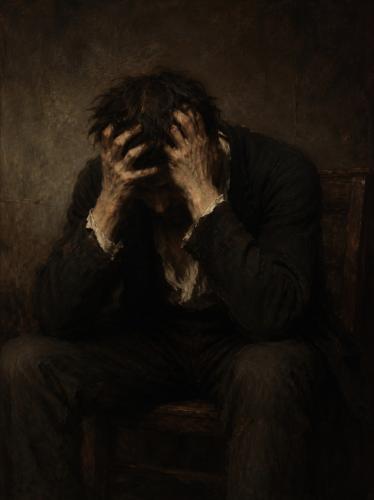
Okay before I start I just wanna say love the profile art for this peice I don’t know what it’s called 😅.

But it really sets the mood and makes me interpret this as a person let’s say 100 yrs ago writing what he feels as there is no there way to explain it which makes sense other than writing it and it makes me think the speaker is desperate to do so .
Anyways I also get this feeling as the algae you used is quite technical and posh you use words like ail which I don’t think you’d come across nowadays which also gives a sense that this was written by a speaker who was from a long time ago. I am loving your chosen style of writing by the way . I don’t know if you can tell I love envisioning what would have brought the speaker to this position.
I think purposefully leaving the mystery not solved as to what is making the speaker sick is it actually physical or is it a mental thing that’s making them sick I don’t know but I think that mystery draws the reader in even more . (Do correct me if I’m misinterpreting).
The personification of the different organs like how the liver weeps and the heart spilling confessions gives me the sense that this is something even the speakers body wishes to be fixed adding to the desperation sort of feel .
Um maybe it’s just me but I found the first line unclear I didn’t know what you meant by “ I have long since mistaken the wound for its physician” I just couldn’t really figure it out . Like are you saying the wound is trying to heal it self and the speaker has realised that’s not enough or I don’t know . I do history in school so I interpreted the physician as physicians during the medieval era who would mainly be for diagnosis instead of cure so that made me think maybe there is no cure for whatever the speaker is suffering with.
I would love to know what you meant when you wrote this if you would like to share. Overall I love this piece. See ya
First of all, thank you so much for taking the time to read this, and I'm glad you liked the artwork! I love that you imagined the speaker as someone from another period. I hadn't necessarily attached a particular era to the narrator, but I can see how the language and the artwork might lead you there. I also find your interpretation of the speaker writing out his feelings because he has no other way of expressing them quite interesting. In truth, he really has no other way of expressing them.
Regarding the opening line, "I have long since mistaken the wound for its physician," I was playing with the relationship between suffering and familiarity. A wound is supposed to be something that requires healing, while a physician is someone who provides that healing. But what happens when someone becomes so accustomed to their suffering that they begin to mistake the very thing hurting them for something that provides relief? It's almost as though the narrator has developed a relationship with his affliction, one that makes him reluctant to seek a cure. So, rather than the wound attempting to heal itself, it's more about the narrator confusing the source of his suffering with something that sustains him.
I also like your interpretation of the organs, especially the idea that even the speaker's body wishes to be fixed. I hadn't considered it quite that way, but I think it adds another interesting dimension to the imagery. The heart and liver almost become witnesses to something the narrator has struggled to confront.
And regarding the mystery surrounding the sickness, I deliberately left it unnamed. I didn't want to establish whether the affliction was physical, psychological, spiritual, or something else entirely. I wanted readers to have the freedom to approach it through their own experiences and interpretations. Of course, I do have my own experience behind it.
The final lines are important to me because the narrator spends so much time looking outward, searching for something to blame, only to arrive at the realisation that he knows what ails him. And perhaps more unsettlingly, it knows him, too.
Thank you again for such a thoughtful reading. I genuinely enjoyed seeing the different directions your imagination took with the poem. And I love that you brought your historical perspective into it. I look forward to reading your own work!